ProactOS

Helping the people who keep the world running make better decisions.

Make every reliability decision count.

Achieving top-quartile reliability has always been difficult. Today, plants are expected to run longer, closer to their limits and more efficiently — often in facilities that were never designed for today’s operating demands, under pressure to control both CAPEX and OPEX, while experienced people are becoming harder to find.

ProactOS gives your workforce the intelligence and context to make better decisions, faster — helping your people get more from the assets and resources you already have.

Your CMMS manages the work. ProactOS helps you decide what work matters, why it matters and what should happen next.

OBSERVE → UNDERSTAND → DECIDE → ACT → LEARN

  1. OBSERVE

    Capture what is happening in the field and across the asset.

  2. UNDERSTAND

    Connect observations, asset context, failure modes, history, controls and reliability knowledge.

  3. DECIDE

    Identify what matters most and support the engineering team in making the right decision.

  4. ACT

    Turn decisions into clear actions and connect them to the existing work process and CMMS/EAM.

  5. LEARN

    Capture the outcome and continuously strengthen the reliability knowledge base.

Illustrative example

Focus your expertise where it matters most.

Industrial teams will always have more observations, issues and potential improvements than they have time to address. ProactOS helps connect those signals to business impact, so your people can prioritise the work that matters most — while keeping the rest of the work visible and managed.

A compressor shows recurring abnormal vibration.

Where the information already sits

  • CMMS and EAM
  • Historian
  • Data platform
  • Engineering systems
  • FMEA and reliability knowledge
  • Field observations
  • Documents and other sources of asset knowledge

The problem is not a lack of data. The information already exists — it is often just disconnected.

The reality

The reliability team already has many things competing for attention: a compressor with recurring vibration, overdue maintenance, operator observations, inspection findings, reliability improvement opportunities, other equipment issues, planned maintenance and improvement projects. They cannot investigate everything immediately.

The question is not “Can we find problems?” The question is “Which problems and opportunities deserve our scarce expertise and resources first?”

Without ProactOS

  • The information needed to prioritise is often spread across the CMMS, EAM, historian, data platform, engineering systems, FMEA, observations, documents, history and engineering knowledge — not missing, just disconnected.
  • Teams may know something needs attention, without immediately seeing how significant it is, what could happen if it is not addressed, which business outcomes could be affected, whether existing controls are sufficient, or how it compares with other competing work.
  • People can spend valuable time on issues because they are visible, urgent or easy to action — without knowing whether they are the highest-value things to work on.

With ProactOS

  • ProactOS connects the relevant asset, failure modes, observations, history, controls and reliability knowledge.
  • It helps the team understand the potential business and operational impact of different issues and opportunities.
  • Higher priority: these issues have the greatest potential impact and deserve engineering attention first.
  • Lower priority: these issues still matter, but can be monitored, planned or addressed later.
  • Lower-priority work is not ignored. Priority becomes visible, so people can consciously decide where to spend their time.
  • Engineers and operational leaders decide what to do. ProactOS does not decide for them.

ProactOS does not simply help you find more work. It helps you understand which work matters most.

Focus your people on the decisions and actions that can make the biggest difference to the business.

Reliability is getting harder. Your people need better support.

Industrial organisations are operating in a more constrained world.

Facilities have physical and design limitations. Operating windows are stretched. Investment decisions are under greater scrutiny. Maintenance budgets are under pressure. And the experienced engineers and technicians who understand how assets really behave are increasingly difficult to attract, develop and retain.

You cannot always redesign the plant.

You cannot always add more people.

You cannot always increase the maintenance budget.

But you can enable the people you already have to make better decisions.

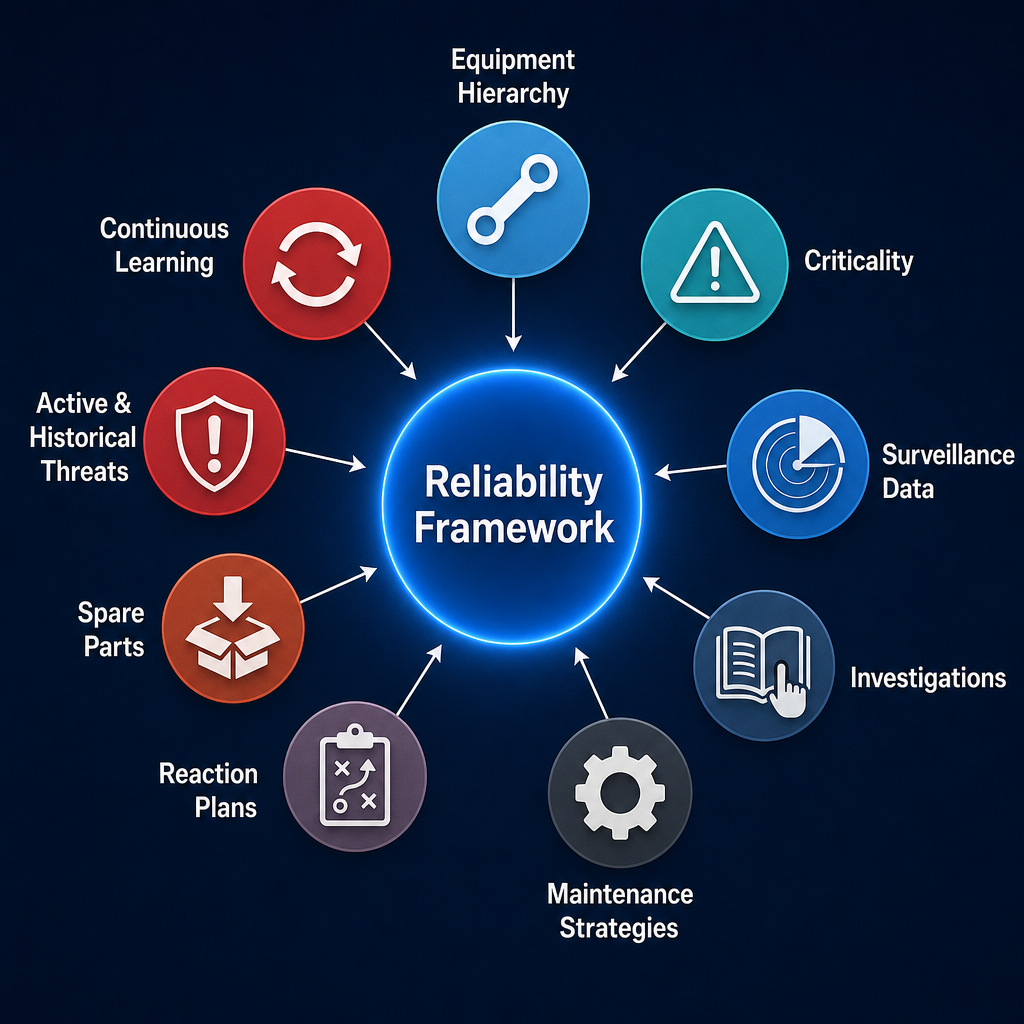
ProactOS brings the reliability context people need into one place — connecting equipment hierarchy, failure modes, maintenance strategy, field evidence, risk and actions.

The result is a workforce that can see what matters, understand why it matters and act with greater confidence and effectiveness.

Reliability engineer on the shop floor

What better reliability also means

More reliable assets and plants tend to run with less waste and lower emissions. Fewer unplanned events, smoother operation, and less energy and material lost to failures and rework.

That follows from better reliability — not from a separate programme, and not something ProactOS can claim on its own.

A reliability intelligence layer across the systems and data you already have

ProactOS does not ask you to replace your CMMS, EAM, data platform or historian. It can work alongside the technology and data landscape you already have — CMMS and EAM platforms, data platforms and data lakes, historians, engineering systems, reliability databases, operational systems, existing AI and analytics, and documents and other sources of asset knowledge, where available. It uses and connects that existing information rather than asking you to recreate it.

Whether your reliability information sits in a CMMS, EAM, data platform, historian, engineering system, documents or a combination of sources, ProactOS connects the relevant context to help your people make better decisions.

Your systems already contain valuable information. ProactOS helps turn that information into the context and intelligence your people need to decide where to focus.

ProactOS does not replace your systems or create another data silo.

Reliability framework connecting hierarchy, criticality, surveillance, investigations, strategies, reaction plans, spares, threats, and learning
  1. Existing technology and data
  2. ProactOS
  3. Context, intelligence and prioritisation
  4. Better decisions
  5. Better action
  6. Learning

Equipment hierarchy

A structured view of the assets you actually operate, aligned with ISO 14224, so reliability, maintenance and operations teams work from the same asset context.

Failure knowledge and strategy

FMEA, failure modes and maintenance strategies in a continuously evolving reliability knowledge base that can be maintained and improved by the people who know the plant.

Field observations and risk

Operators and technicians capture what they see in the field. ProactOS connects observations to assets, failure modes and risk so teams can focus attention where it matters most.

From insight to action

Turn identified risk and reliability decisions into agreed actions and maintenance work — for example alongside the work orders already managed by your CMMS.

Causal investigation when it matters

Use structured causal investigation when a failure, recurring problem or operational exposure warrants deeper investigation — without forcing every issue through a heavyweight process.

A shared view for the shift

Put the same risks, priorities, actions and status in front of the people who need to act, from the reliability engineer to the supervisor to the shop floor.

Amplify expertise. Don’t replace it.

AI can help identify patterns, connect information and surface what deserves attention.

But industrial decisions remain human decisions.

ProactOS is designed to amplify engineering expertise — not replace engineering judgement.

The people who own the plant remain in control of deciding what to do.

Built for the people accountable for reliability

Who

VP Reliability, Head of Asset Management, Maintenance Director, Plant Manager, Reliability Engineer — and their teams and organisations, the people who keep the assets running.

Where

Processing plants, waste-to-energy, chemicals, utilities, food, manufacturing and other asset-intensive industries.

Start with one unit

  • A structured asset and reliability context for one selected unit
  • Critical failure modes and threats connected
  • Relevant observations linked to assets and failure modes
  • Current reliability exposure identified
  • Priority reliability actions defined
  • Evidence of decisions and work influenced by ProactOS
  • A clear recommendation to expand, adapt or stop

Start with one unit. Prove the value. Then decide.

How a 90-day pilot works